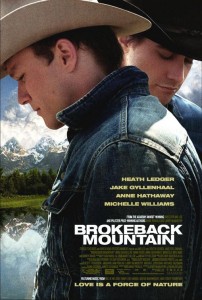
#191 Brokeback Mountain, Ang Lee, 2005
Cast: Heath Ledger, Jake Gyllenhaal.
Ang Lee is up for another Oscar this year for directing Life of Pi, so it seems like a good time to review his previous winner of that same award, 2005’s Brokeback Mountain.
This film, based on a 1997 short story from the New Yorker about “high school drop out country boys with no prospects, brought up to hard work and privation, both rough mannered, rough spoken, inured to the stoic life” is known to many as “that gay cowboy film”. That’s a description which — even ignoring the tone of dismissiveness — doesn’t sit well with some people. Wikipedia quotes one commentator from the American National Sexuality Resource Center[1] as saying:
Brokeback Mountain is a not a movie about gay people, and there are no gay people in it. There. I said it. Despite what you may have read in the many reviews that have come out about this new cowboy feature film, Brokeback Mountain is a bisexual picture. Why can’t film reviewers say the word ‘bisexual’ when they see lead characters with sexual and romantic relationships with both men and women? I am unaware of a single review of Brokeback calling the leads what they are—a sad statement on the invisibility of bisexual experience and the level of biphobia in both the mainstream and gay media.
I think this is the most interesting question you can ask about this film. It reminds me of secondary school English classes where we argued about whether or not Prince Hamlet was really insane. I’m glad I read that opinion, because I would otherwise have continued on blind to the suggestion that the characters were anything but 100% gay.
But in the end I have to conclude that the characters of Ennis Del Mar and Jack Twist really are gay. Not bisexual, but homosexual. What’s more, I don’t think the story makes sense otherwise.
If you assume the characters are bisexual then this is a story of two men who cheat on their wives repeatedly for two decades. There’s little to excuse their actions, and the story contains little that merits sympathy (except for their families, but that’s not who the story is about).
But if Ennis and Jack are gay then their marriages are false ones, attempts to contort their lives to fit with the expectations of an inflexible society. And here is introduced the necessity for sympathy. It becomes a story of two people granted a glimpse of what their lives should be allowed to be — lives of joy and support from the person they truly love. Two people given just enough freedom to be tantalised by the possibility of true love, but ultimately prevented from getting to live that life together. It doesn’t absolve them for the hardship they cause their wives, but it makes the protagonists the tragic victims of circumstance rather than the perpetrators of their own misery.
The film mirrors the lives of its characters in that it is defined by their relationship but it doesn’t actually feature all that much of them being together. After their first summer together herding sheep on Brokeback, most of the screen time is spent on the problems in the two men’s regular lives caused by their relationship with each other. You could argue that it isn’t about the romance so much as it is about the resultant difficulty of living their separate lives.
More than anything it’s about how, when faced with an unchangeable situation, how you survive is determined by how you choose to live with it. Jack, played by Gyllenhaal[2], is sustained by his optimism and his efforts to find a way that they can be together, however slim the possibility. Ennis, played by Ledger, is slowly destroyed because he never acknowledges that hope.
–
In 2005 Brokeback Mountain was beaten to the Best Picture Oscar by Crash. I saw Crash at the time and haven’t rewatched it since, so I can’t offer a very detailed review, but in my opinion Brokeback is the better film. It’s certainly a lot higher on the 500 list than Crash, which comes in at only number 460.
[1] I realize that starting a review by quoting Wikipedia is like opening a debate with a dictionary definition. I’d link to the original article but it doesn’t seem to be online anymore.
[2] See this video on how to “correctly” pronounce Gyllenhaal.
I still can’t believe Crash beat this to the Oscar. Well, I can, because the Oscars are totally random, but it still sits oddly.
Disclaimer: I haven’t watched the film, so I’m not commenting on the accuracy of your review.
I think there’s a flaw in the logic of your review. They can be bisexual and their true love can be each other and not their wives. You don’t need them to be homosexual for that to be true.
Furthermore, it’s not a bucket, but a spectrum. Kinsey did a lot of research on that and developed what we now know as the kinsey scale: 0 is heterosexual, 6 is homosexual, 3 is bisexual. Almost nobody is in exactly in those positions and people change over time. Heck, some days, if you ask me in the morning and in the evening I’ll give different answers.
But there’s one more case. What if they truly loved their wives and they also loved each other? That’s completely possible and one love doesn’t detract from another. Polyamory is even less accepted than homosexuality (and possibly bisexuality) in today society. So many people are poly and since they never stumble upon the concept and community, they just believe they are broken. It’s so sad.