I’ve written a lot less on this blog over the last few weeks. Partly that’s due to having had less time to write than usual, and partly due to having less time to watch films. In either case it was mostly down to the distraction of having recently got married. So what better way to return to the film blog than with a 400-year-old comedy about marriage?
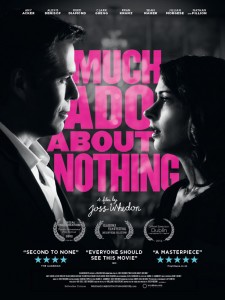
Much Ado About Nothing is on very limited release, but as usual you can find it at a reasonable number of London cinemas anyway. We found it at the Curzon in Soho, a cinema I’ve been aware of for years but which I’d never actually been to before.
The film will primarily attract Joss Whedon fans at first, not only because he adapted, produced and directed it and composed the score, but also because the cast overflows with alumni of Buffy, Angel, Firefly and Avengers Assemble. It would be a shame if it never found an audience outside of the Whedon faithful though. It’s an excellent Shakespearian adaptation, probably the best since Luhrmann’s Romeo + Juliet.
As with any centuries-old work there’s the potential to have trouble with the unfamiliar dialog, but the romantic comedy plot is straightforward enough that no-one should have trouble following it, even if you may miss a few of the details. I struggled a bit to figure out who was who at the beginning but had no trouble following the rest of the film despite that. For me, oddly for a fan of verbal wit, most of the big laughs came from physical comedy. Nathan Fillion and Tom Lenk are hilarious for every second of their screen time, but — in terms of comedy and otherwise — Amy Acker is the person who really steals the show.
Congratulations on the nuptials! We went to see the world premier of this back in February at the Dublin Film Festival. We both really enjoyed it, especially the “overhearing” scenes, and all of Nathan Fillion’s bits. Himself also took his middle daughter to see it for her 12th birthday when it was on general release, she thought it was really, really good. Which I think goes to show just how good an adaption it is that a child can also enjoy it.